Mistake one: glancing at the roof before the wires
After a storm the eyes go straight to the roof, and the wires deserve the first look. PSE&G's advice to customers: assume any downed wire carries current, report it to 911 or to the utility on 1-800-436-7734, and never try to cut away a tree caught in the lines.
Ladders give a second reason to look up. NIOSH names ten feet as the distance to keep a ladder from power lines. With wires down near the house, the roof waits until the utility has cleared them.
The six, side by side
| Habit | What happens | What helps |
|---|---|---|
| Looking at the roof before the wires | A ladder or a hand meets a live line | Check the sky first, then 911 or PSE&G |
| Pressing on the stain | Wet drywall breaks and drops | Keep clear, outline the stain and date it |
| Climbing up to look | Wet rungs and wet shingles slip | Binoculars, a window and the attic hatch |
| Throwing the evidence out | A claim loses its record | Dated photos, kept items, saved receipts |
| Saying yes at the door | A deal with no contract | A written contract and a lookup first |
| Letting a downspout empty at the foundation | Water pools at the wall or in the basement | Extend it downhill, away from the house |
Mistake two: pressing on the stained ceiling
A brown patch invites a finger. Pennsylvania's environmental agency says drywall that stays wet turns very fragile and breaks apart when bumped, so one poke can bring down far more than the stain. A ceiling that bows or sags may still be holding the water that stained it.
Distance is the remedy. Nobody, pets included, stays in the room under it; dial 911. A flat stain is different: draw a pencil line around its edge, write the date, and look again after the next rain.
Mistake three: going up to see for yourself
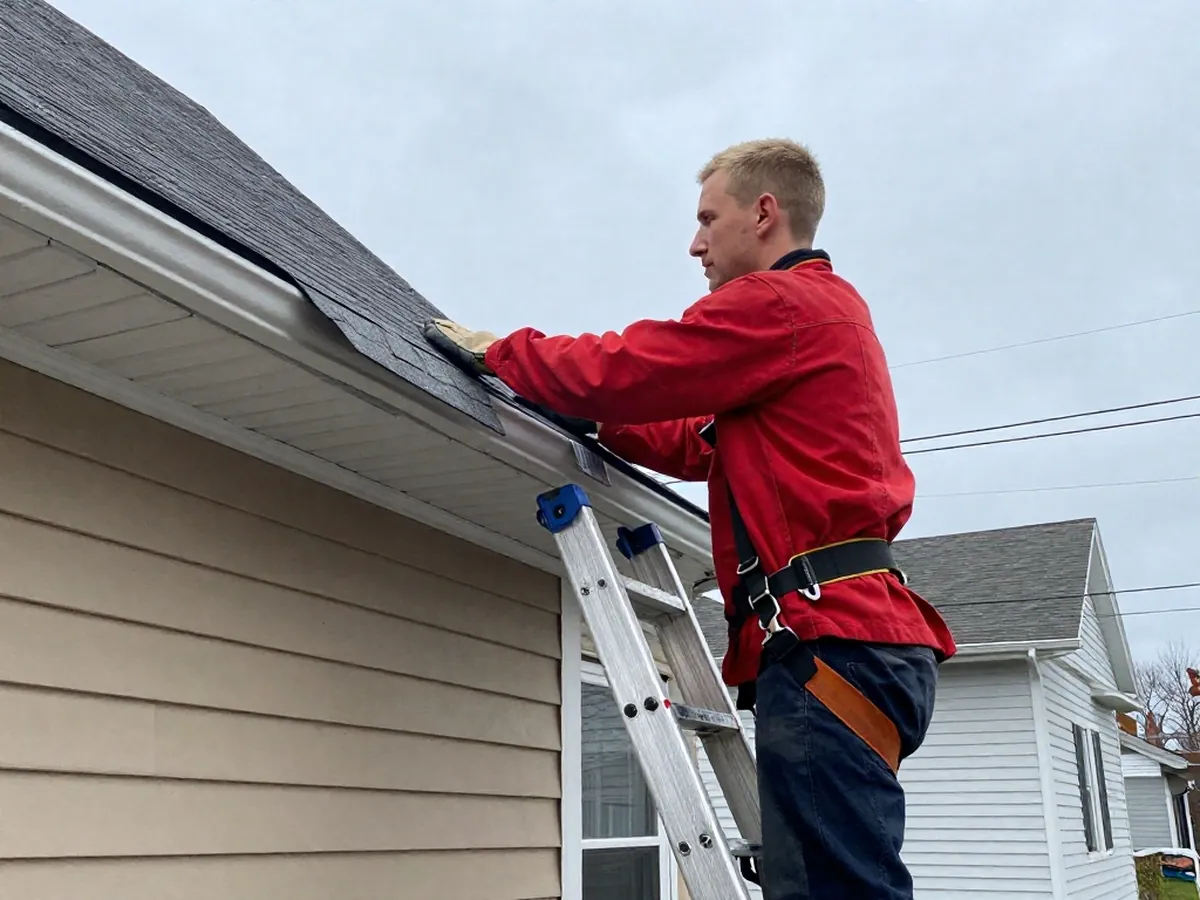
New York State's health department gives the ladder basics. Set the base one foot out for every four feet of height, extend the top three feet above the landing, keep three points of contact, and stay off ladders when it is wet or icy. NIOSH reports that more than 100 people in the U.S. die each year in ladder falls, with thousands more hurt.
A storm leaves wet shingles, wet rungs and sometimes a limb in the way. Binoculars from the yard and a flashlight at the attic hatch tell a roofer most of what the climb would.
Mistake four: throwing the evidence away
The state insurance department says to photograph damage before disposing of anything, to keep damaged property, to save receipts for temporary repairs and to call the insurer promptly. It adds that the insurer picks the adjuster and rules on coverage, and that a policyholder can hire a contractor other than the one the insurer recommends. Its hotline is 1-800-446-7467, 8:30 to 5 on weekdays.
A shoebox or a phone folder is enough: dated photos of the lawn, each side of the roof and every stained ceiling, with each receipt tucked in beside them.
Mistake five: saying yes at the first knock
The state attorney general's tip sheet warns about unsolicited offers and large up-front payments, and says to get the deal in writing. For work above $500, Administrative Code section 13:45A-16.2 has the contract written and signed by everyone, with later changes written down and signed as well.
The Ahead of the quote list names the state lookup for contractors and what a contract has to contain. A few minutes there separates a stranger from a business with a record.
Mistake six: letting the downspout empty at the foundation
Rutgers did the sum on an 800-square-foot roof: an inch of rain delivers roughly 500 gallons to one downspout. Delaware's environment agency says to run downspouts downhill and away from the structure, because pooling water can damage a foundation or flood a basement, and to clear gutters about twice a year.
Wallington knows what river water does. CBS New York reported the Passaic flooding the borough twice around Hurricane Irene in 2011, and Bergen County's hazard plan maps 17.58 percent of the borough in the 1 percent floodplain. Roof water that adds to that is the share a homeowner can steer.
When does the checking stop and the calling start?
The checking stops where the ladder starts. Missing shingles, dented metal or a fresh stain call for a roof inspection, and what follows a storm is covered under storm damage repair.
Call (973) 791-8220 and walk through what you noticed, starting with the first sign. If you rent, the owner needs to hear about it first.